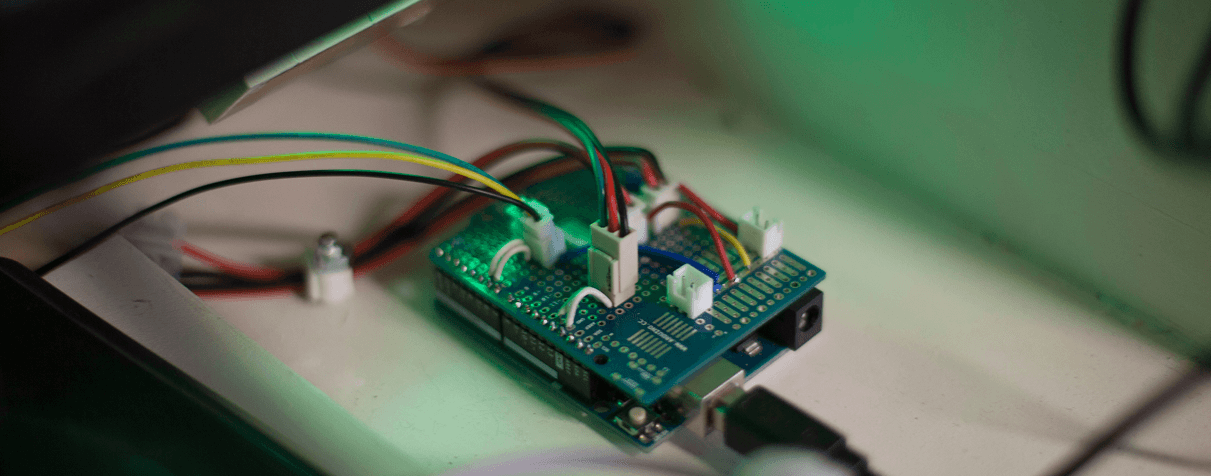
Created a Blockchain Healthcare Prototype

European Commission
Created CareAI, a speculative blockchain healthcare prototype exploring anonymous malaria testing, token-based incentives, and community-owned health data.
Category / Type
Speculative design; blockchain; healthcare data governance; civic trust; data ownership; consent systems; decentralized records; public-sector innovation.
Client / Venture / Internal
Speculative design and prototype work presented to the European Commission through the Joint Research Center’s #Blockchain4EU exploration.
Context
CareAI emerged from questions around healthcare data, data sovereignty, and the value of anonymous civic participation. As more social and technological systems depend on data, the people who generate that data often lose control over its ownership, value, and use.
The project explored how blockchain and distributed ledger technologies could support more trustworthy healthcare data systems, especially for underrepresented groups who may need care while retaining anonymity.
Wicked Problem
Healthcare data can create public value, but the people most absent from formal systems are often the people whose data could most improve those systems.
Undocumented migrants, ethnic minorities, the homeless, and other underrepresented communities may be underserved by healthcare systems while also having strong reasons to protect their identity. Traditional data collection can feel extractive: people provide sensitive information, while institutions capture the value.
The challenge was to imagine a system in which people could receive anonymous healthcare feedback, retain agency over their health data, consent to how their data is used, and be compensated when their anonymized data creates value for governments, NGOs, or research institutions.
Solution
Lucas created CareAI as a speculative healthcare prototype for anonymous, AI-supported testing and blockchain-based data governance.
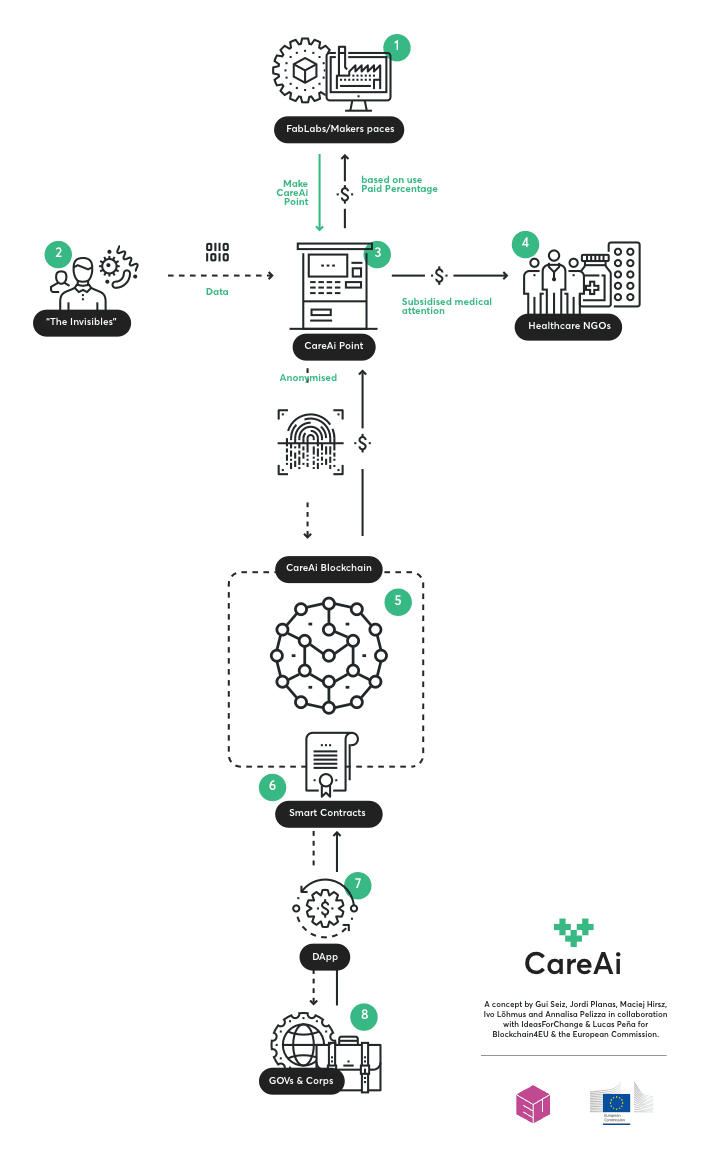
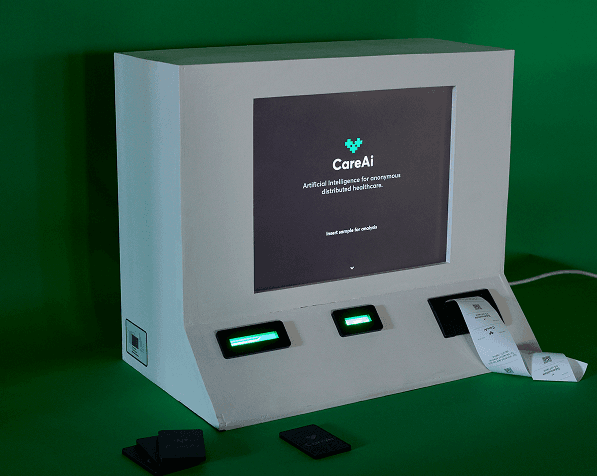
The scenario centered on malaria testing through a CareAI Point: a fabricated health-testing device built from an open-source blueprint. A person could anonymously contribute blood data, receive AI-supported healthcare advice with a confidence rating, and receive a QR code that participating healthcare NGOs could use to claim support for the care provided.
The contributed data would be anonymized and securely stored on blockchain infrastructure. Smart contracts would manage rights, permissions, consent, and access to health data. A distributed application would allow approved governments, NGOs, or enterprises to access aggregate insights by purchasing tokens, with economic value flowing back to healthcare NGOs and to the creators or maintainers of the CareAI points.
The work used token-based payments not as a speculative-finance gesture, but as a civic mechanism: a way to incentivize testing, compensate anonymous data contribution, and build trust around health data governance.
Core Interaction Stages
Fabrication SMEs produce CareAI Points from an open-source blueprint.
An underrepresented or undocumented person contributes blood data into the CareAI Point.
The CareAI Point uses AI-supported diagnostic libraries to provide healthcare advice with a confidence rating.
A QR code lets participating healthcare NGOs claim support for care provided to the individual.
The contributed data is anonymized and stored securely through blockchain infrastructure.
Smart contracts manage rights, permissions, consent, and access to the health data.
A distributed application allows approved institutions to access data through smart contracts.
Governments or enterprises purchase tokens to access insight, with tokens funding NGOs and system maintenance.
Outcome / Impact
CareAI was presented to the European Commission as a forward-looking exploration of blockchain, healthcare data governance, and civic trust.
The project turned abstract questions about data ownership, consent, and decentralized health records into a tangible prototype and interaction model that policymakers and innovation teams could discuss.
Speculative blockchain healthcare prototype presented in a European Commission context.
Focused on malaria testing, anonymous healthcare feedback, and token-based incentives.
Explored data ownership, health data governance, civic trust, consent, and decentralized records.
Created visual system diagrams and a physical CareAI Point prototype.
Role / Contribution
Speculative designer, creative technologist, and prototype lead.
Lucas developed the CareAI concept, interaction model, visual system logic, and prototype framing, translating blockchain and healthcare data governance into a public-facing speculative experience.
Supporting Proof / Artifacts
CareAI speculative prototype.
European Commission / Joint Research Centre #Blockchain4EU presentation context.
CareAI Point physical prototype.
System diagrams for fabrication, anonymous testing, blockchain storage, smart contracts, token flows, NGOs, and institutional data access.
Case-study draft and visual assets supplied by Lucas.