Taught AI, Futures, and Weak Signals

IAAC, Fab Lab Barcelona
Built curriculum and lectures for Designing with Extended Intelligence, helping design students understand AI as a creative, ethical, and strategic design material.
Category / Type
Education, AI and creativity, design futures, human-machine collaboration, curriculum design, lectures and workshops.
Client / Venture / Internal
Academic work with IAAC, the Institute for Advanced Architecture of Catalonia.
Context
Designing with Extended Intelligence was taught inside the M.A. Design for Emergent Futures context at IAAC. The course introduced designers to machine intelligence, tooling, ethics, and the strategic design of products, applications, services, and systems that extend human intelligence with machine capabilities.
The course was taught before generative AI became a mainstream design tool, when most designers still needed a conceptual and practical bridge into machine learning, intelligent systems, predictive interfaces, ethics, data, and computational creativity.
Wicked Problem
Teaching AI to designers is not just a technical problem.
Designers need to understand enough machine intelligence to work with it, but not reduce the discipline to tool demos. They need to reason about data, bias, ethics, language, agency, intelligence, automation, and the social consequences of systems that classify, predict, recommend, and generate.
The deeper challenge was giving students a way to design intelligent things, with intelligent things, and for intelligent things — while still asking what intelligence means, whose values are encoded, and how design can shape the relationship between humans and machines.
Solution
Lucas developed curriculum and lectures that connected AI foundations to design practice, ethics, and speculative applications.
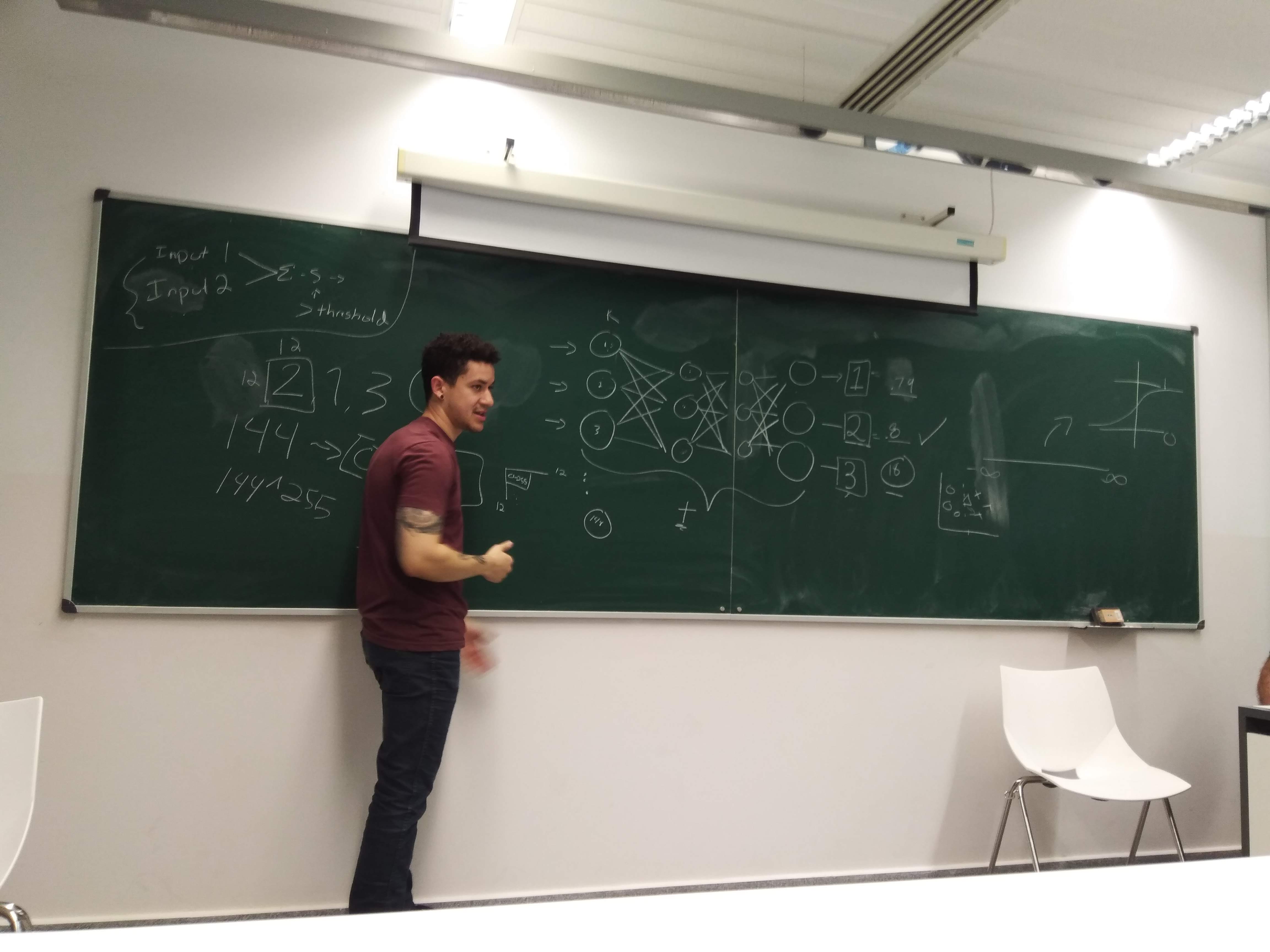
The course introduced students to concepts such as machine intelligence, symbol grounding, Turing tests, rational agents, predictive UX, machine learning approaches, neural networks, computational creativity, cybernetics, bias, trust, and AI ethics.
Students applied the material through design exercises and intelligent-agent concepts, translating philosophical and technical questions into product, service, and system ideas. Student reflections describe the course as a week of AI, tooling, ethics, creativity, and strategic design for machine intelligence.
Rather than teaching AI as a detached technology, the course framed it as a design material with consequences: a way to extend human perception, decision-making, creativity, and collaboration when used critically.
Outcome / Impact
The curriculum helped students develop AI literacy and creativity and contributed to student placements in renowned European design and research labs.
Developed and taught M.A.-level curriculum on Artificial Intelligence and Creativity.
Equipped students with foundational understanding of machine intelligence, tooling, and ethics.
Introduced strategic design methods for products, applications, services, and systems that extend human intelligence with machines.
Supported student pathways into European design and research labs.
Role / Contribution
Course instructor, curriculum designer, and AI/design futures educator.
Lucas created lectures, structured learning objectives, taught core AI and creativity concepts, and helped students translate machine intelligence into design methods and speculative product thinking.
Supporting Proof / Artifacts
IAAC / M.A. Design for Emergent Futures teaching context.
Student reflection: https://mdef.gitlab.io/2018/veronica.tran/reflections/designing-with-extended-intelligence/
Student reflection: https://mdef.gitlab.io/2018/alexandre.acsensi/mdef.t1/w6designingwithextendedintelligence.html
Curriculum and lectures on AI, tooling, ethics, computed creativity, and predictive UX.
Student placement in renowned European design and research labs.
Related Teaching: The Atlas of Weak Signals
This teaching work is also connected to The Atlas of Weak Signals at Fab Lab Barcelona, which helped students and practitioners map emerging social, technological, environmental, and cultural signals before they harden into obvious trends.
Together, Designing with Extended Intelligence and The Atlas of Weak Signals formed a broader teaching practice around futures literacy: understanding intelligent systems, reading early signals of change, and translating uncertainty into design action.
Weak-signal mapping for futures and speculative design.
Futures literacy across AI, technology, culture, and emerging behaviors.
Public academic context through IAAC and Fab Lab Barcelona.